

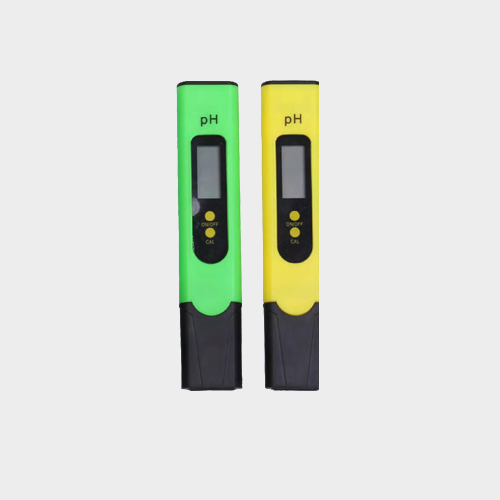
| Range | 0.0-14.0pH |
| Resolution | 0.1pH |
| Accuracy | +/-0.2pH +/-0.1pH(at20ºC/68ºF) |
| Batteries | 3*1.5V(AG-13Bu?onBa?ery) |
| Life | Approx.700hours of use |
| Environment | 0ºC~50ºC(32ºF-122ºF) |
| Relative Humidity | <95% |
| Dimensions | 150mm*29mm*20mm |
| Trimming | By Potentiometer |
| Weight | 51g |
| Battery | Cr2032 |
| 1000 Hours for continuous Testing | |
| LCD Display | 11*21mm |
| Auto-Hold | |
| Auto-Off | |
| Clear the Data to Zero for each Test | |
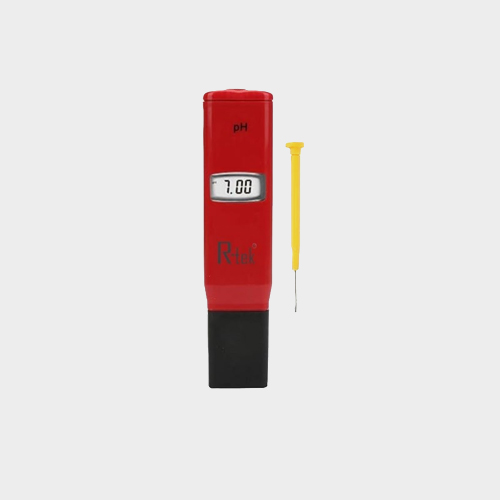
A pH Meter is a digital measuring instrument used to determine the acidity or alkalinity of a liquid. It provides a numerical pH value based on the hydrogen-ion concentration of the sample.
Most standard digital pH meters measure from 0 to 14 pH. Some advanced models may offer a wider or specialized measurement range.
A pH meter uses a pH electrode to detect the hydrogen-ion activity in a liquid. The electrical signal generated by the electrode is converted into a pH value and displayed digitally.
pH buffer solutions are solutions with known and stable pH values used to calibrate pH meters. Common calibration points include pH 4, pH 7, and pH 10.
A pH electrode should generally be kept moist using the recommended electrode storage solution. It should not normally be stored dry unless specifically permitted by the manufacturer.
Yes. pH meters can be used for soil-related applications when used with an appropriate soil-testing method, electrode, and sample preparation procedure.
A quality digital pH meter provides convenient, repeatable, and easy-to-read measurements for laboratory, industrial, environmental, agricultural, and water-testing applications.
